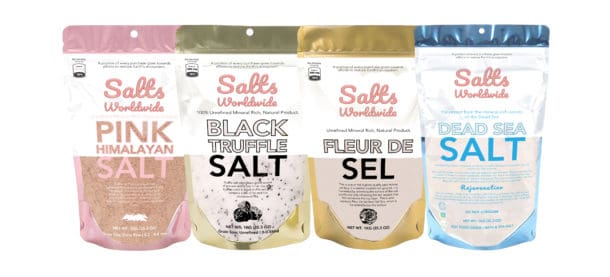
The term “sea salt” is sometimes incorrectly used. Sea salt is a rock salt mined from the sea bottom or seas. There are many types of sea salt and each type has its own set of characteristics. They vary in chemical make-up, density, and amount of iron present. The most common types of sea salt are kosher sea salt chloride. They differ primarily in composition.

Sea salt contains trace minerals such as sodium, potassium, calcium, magnesium, iron, boron, and phosphorus. Because of its abundance in these trace minerals, sea salt has a unique and diverse taste. It varies from salty and sweet to fresh and sour depending on the concentration of trace minerals. Sea salt has no discernible taste, whereas regular table salt has a salty, sweet or sour taste depending on its presence of trace minerals.
Kosher sea salt is harvested from the sea floor at sea level and is more dense than table salt. As it evaporates, its mineral makeup comes to the surface making the salt resemble regular table salt. Although kosher salt has no known health benefits, many people prefer to buy kosher over regular table salt because they believe that kosher has less chemicals. On the other hand, not everyone believes that kosher has less nutritive value.
In contrast to table salt, kosher salt deposits evaporate slowly and take longer to return to the sea. This process makes kosher salt less expensive because the salt crystals are smaller and heavier. Salt crystal sizes range from very small beads to large crystal sizes. Larger crystals are generally more expensive because they contain more minerals and because the process to extract them from sea salt takes longer.
The difference between kosher salt and regular table salt is determined by the method of harvesting. Sea salt is harvested by carefully scraping the ocean floor and breaking the stone rocks on the sea bed. When the rocks are broken, the minerals are released. The water then slowly evaporates, leaving behind the lighter crystals of kosher salt. The process of drying the crystals takes much longer and can take months.
Kosher sea salt is made without any chemical additives, as it is required to be completely natural. It consists of 95% potassium chloride and 5% other minerals, mostly magnesium, iron, and sodium chloride. As mentioned above, the smaller crystals absorb more water and do not dissolve, but the larger ones tend to settle to the bottom, making them heavier and having less sodium chloride content. This makes kosher salt less sodium chloride than coarse sea salt, which is just what we want.
Table salt is made by evaporating water and grinding it with a sea salt grater or a mill. Because the water evaporated, minerals have been removed from the food and therefore the resulting salt is pure. This type of salt can be used for baking, seasoning, and for pickling and preserving. There are still trace amounts of magnesium and iron in these types of salts, but not as much as you would find in kosher salts. They can also be used for cooking, although using kosher and coarse sea salt together can produce a more concentrated taste.
A downside of kosher salt mines is the pollution that is caused by all of the tons of rock and debris that need to be removed from the sea bed. This process is very environmentally damaging. However, in coastal areas where there is a concentration of sea salt, this problem is not as problematic because the problem of pollution is not as great. This means that kosher salt mines are really more of a boon than a bane.